

Article Summary: The article discusses affordable housing in Africa, where 800 million people live in informal settlements despite high population growth. Experts acknowledge that private capital can’t solve the issue due to low margins, suggesting governments and developers must collaborate. Possible solutions include subsidies, mandatory affordable housing elements, and temporary incentives to stimulate economic multipliers.
‘Housing is a human right, but we need private capital to unlock it.’
This phrase has stuck with me since last week at MIPIM. It’s interesting to see that even on the global stage, developed markets still have affordable housing at the nexus of real estate debates and conversations. Unfortunately, I left the conference with more questions than answers, specifically about affordable housing.

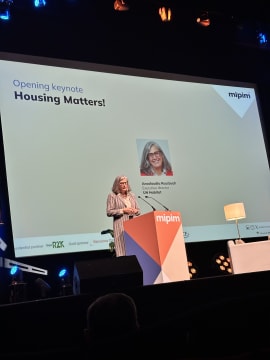
In her opening address, the Executive Director of UN-Habitat (Anaclaudia Rossbach) explained that almost 3 billion people are living in inadequate homes globally, with 1 billion living in informal settlements and up to 300 million facing homelessness. In Africa specifically, which she described as a continent where housing urgency and market opportunity converge (sharp!), 800 million people are moving to cities, yet 50% of the urban population is still in informal settlements. This was highlighted as an opportunity for potential investors to consider. If we overlay this with Africa’s poverty statistics (45.5% in 2025), it gives a clearer picture of where some (not all) of the demand in that large opportunity lies. This is a harder story to tell.
Can profit seeking private capital solve Africa’s affordable housing problem, especially when most of the opportunity is in the low to zero margin segment? It’s an easy no, which was acknowledged. Given the type of demand, this conversation needs to be led by governments, with technical support from property developers and investors. In many African countries, however, the private developers end up at the centre of public discourse on the topic. Though a handful of initiatives sponsored by the Kenyan, Botswanan, and, more recently, Nigerian governments are attempting to change this narrative, from what I see, 1,000x more effort will be required if any real progress is to be made.
In Nigeria, for example, as construction, land and transaction costs have risen over the last 3 years, many property developers are choosing to move up a property class to ensure their businesses remain profitable. This has meant that middle-income developers are pushing to do more deluxe housing, deluxe housing developers are opting to enter the luxury space, and luxury developers are looking to land their first ultra-luxury project. Hence, there are fewer and fewer operators delivering even regular, accessible, or middle-income housing, much less affordable housing.
So what do we do?
In Europe, government participation through large-scale social housing schemes is a major difference in how they have tackled housing delivery on the affordable housing spectrum. How can we replicate in Nigeria or in Africa? Do we want to? I think it can help. Subsidies and partnerships with residential developers typically support the delivery of social housing. However, subsidies in Africa are a melting pot for corruption, and most countries are pushing to remove them for good. To my surprise, in this same panel where this was acknowledged, it was unanimously confirmed that affordable housing cannot be achieved without subsidies. Ah.
What other levers exist?
Mandatory affordable housing elements as part of any residential development, like Section 106 in the UK or ‘Inclusionary Housing’ policies in Europe, have been suggested. In Nigeria, initiatives like this will almost certainly push already high prices to new peaks or at least slow new supply additions.
Kenya’s controversial but somewhat effective introduction of housing levies has led to the delivery of ~2,000 centrally located housing units since the policy was introduced a few years ago. This falls short of their initial goals, but there must be lessons that can create a playbook for other African markets to follow. We wrote a few notes on the topic when it was launched.
Also posited was that subsidies don’t have to be permanent. Since housing is an economic multiplier, a (finite) subsidy in this segment will stimulate many more segments of the economy. I believe the multiplier effect is the same line of thinking as the single-digit MREIF (Ministry of Finance Incorporated Real Estate Investment Fund) backed mortgage loans in Nigeria.
Anyway, it’s not news that affordable housing delivery is complex. Watching global leaders in real estate actively debate its solutions just gave me renewed context on the amount of work we have to do, especially in Africa.
Each of the solutions discussed, some not mentioned in this note, has its bright spots and its downsides. It will, however, take much more intentional leadership from African governments on the housing conversation to get us to the next level. How do you think affordable housing delivery can be improved in Africa?


Join The Discussion